
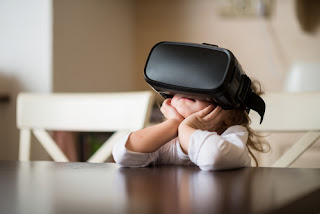
Image 1 – Novak M (ND) – ‘Child with virtual reality headset sitting behind table indoors at home’ (photograph)
Hi. My name is Marie Wiseman and today I’d like to talk to you about the Digital Age – How Consumers Use Technology and its Impact on Their Lives.
The internet was first conceived in the 1960s when the US government used it to transfer data between their early computers. In 1983, a communications method was established which allowed different networks connect with one another. And so the internet was born.
Over the next 10 years, significant developments in technology meant the cost of owning and running a computer dropped significantly, allowing the public to begin accessing the internet.
In the mid-1990s just 0.4% of the world’s population had access to the internet. Today it’s 65.6%.
So what has driven this growth?
Firstly cost. In the 1960s a computer would set you back $700k. Today the average cost of a computer is just $400.
Second is size. The computers of the 60s and 70s were enormous. Today we wear them on our wrists and carry them in our pockets.
The creation of the World Wide Web in 1993 was a significant development. From this came the first search engines and websites.
Another big development has been increased speed.
Who remembers the sound of dial-up? The arrival of Broadband in 2000 was a game changer. In 1993 it took more than a day to download a movie, today it takes mere seconds. Less than 5 years after its arrival, Broadband had overtaken dial up in US homes.
With the arrival of Wi-Fi we were able to move around in our homes using the internet and use multiple devices. Then came mobile broadband.
Today technology features in every part of our lives. From the public sector such as healthcare, to government. We can gain a degree from the comfort of our homes. And of course in our personal lives. We’re woken by an alarm on our phone, use a computer at work, track how fast we’re running at the gym, meet friends for dinner, paying our bill via card reader, before heading home to watch Netflix on our smart TV.
Online communication has been increasing for years and the pandemic has pushed this even further. Zoom has almost become a verb in the past year.
69% of Irish households shopped online during 2020 with the highest incidence being for clothes, shoes and accessories. Online sales in the US grew 32.4% last year, and Moshin predicts over 2bn of us will shop online this year.
The average UK household now has 10.3 internet-enabled devices, an increase of 26% vs 2017. Amongst households with 3 or more children this number is higher still at 15.4.
78% of us now own a smartphone, whilst tablets, smart TVs and wearables have grown hugely in the last 10 years. On the reverse side desktop PCs and MP3 players have seen substantial falls in penetration.
So how do consumers search for information? Google accounts for 92% of all searches today with 3.5b Google searches taking place daily.
More and more we’re expecting our search to be localised, whilst 40% of all internet searches in the US now use voice. Google lens allows us to identify text and objects, whilst reviews really matter. Indeed 88% of consumers trust online reviews as much as personal recommendations.
The majority of searches now originate from a mobile and, social media matters. Facebook was the most searched keyword on Google in 2019.
Video is another big trend today. A few fun facts
o 500 hours of video are uploaded to YouTube every minute – that’s 2 days’ worth of content a minute!
o 66% of us turn first to video when we look for information
o And over 75% of videos are viewed on a mobile
So all this is good news right? There are indeed a lot of positives
o The world has become smaller and it’s easier and cheaper than ever to keep in touch which has made the last 18 months much more bearable
o Indeed Covid has proved that physical presence isn’t always necessary in work, which has opened up the job market.
o Many dangerous jobs of the past are now being taken on by robots
o And all of this is bringing prices down
o We have increased access to education – look at how schools responded during the first lock down.
o Our smart homes are saving us money and helping the environment.
o Process automation is delivering higher productivity and reliability
o And it’s a faster world. Buy a book on Amazon tonight and you could be reading it in the morning.
However, there are downsides
o The faster pace and ever-changing technologies can be overwhelming
o There’s a sense of ‘always on’ – we find it hard to put the phone away
o We’re becoming dependent on technology. Think back to the HSE hack earlier this year and the impact that had
o Obesity is on the increase. We no longer have to move about
o There are privacy issues and it’s all too easy for children to access content that’s inappropriate or harmful
o And it’s also brought about significant change to more traditional business sectors. An example is travel agents. Irish firm JWT shut its doors for the final time in April of this year. Another is Kodak. One of the best known brands in Ireland in the 70s and 80s, it emerged from bankruptcy in 2013 but as a much smaller version of its former self.
So what does the future hold? Blitz predicts the demise of keyboards, mouse and screens. ‘The web will appear in the real world, not just on glass screens’ he says.
How we search will continue to evolve, with voice search having more of a role, whilst invisible implants will help us modulate our hearing and dial up or down sounds around us. He believes neuro-engagement is in our future – a means of communicating with small gestures and gaze tracking, whilst advertising will become increasingly tailored.
Ghosh predicts wearables such as smart watches will bring about a health data revolution. He believes our homes will become smarter with home robots on the cards, whilst our industries and cities will continue to become smarter.
So in summary? Blitz summed it up when he said ‘The internet is at best, in its adolescent years’. There’s much more to come. The internet has made our world better in so many ways and this will continue. However, there are downsides, particularly around our autonomy, privacy and the impact on our physical and mental well-being. And of course in the wrong hands all this progress can be dangerous.
I shall leave you with a quote from the inventor of the internet, Tim Berners-Lee. ‘The web as I envisaged it, we have not seen it yet. The future is still so much bigger than the past.
Thank you.
 Marie Wiseman Digital Marketing
Leave a comment